Showing posts with label kevlar. Show all posts

Friday, 28 September 2012

Review of the Bluewater Mist

In December of 2010 I sold my Solo Plus and in July of 2011 I sold my old tandem canoe to make room for a new canoe that I hoped would fulfill my desire for a larger, more efficient, more wave-hardy solo canoe.

After months of research I ordered a Bluewater Mist from Peter Harris at Pacifica Paddle Sports in Victoria BC, Canada. In previous posts I wrote in some detail about how I finally decided on the Mist, and here, over a year since I began to paddle the canoe, I give a detailed review of the experience.

First some photos of the beautiful hull:
Bluewater Mist on Durrance Lake
Bluewater Mist on the Shore of Elk Lake
Bluewater Mist on Dickson Lake
Bluewater Mist on Westwood Lake
Bluewater Mist on Muriel Lake

Some Initial Glitches
I received the Mist towards the end of August, 2011, and was disappointed to discover a number of flaws with the hull which included manufacturing defects and damage from shipping. Both Peter at Pacifica Paddle Sports and Bluewater representative Brent Wood were quick to acknowledge the flaws and Brent offered a new boat to replace the one I had received, allowing me to paddle it until the new one arrived. I asked if the skid plates that were installed on the first canoe could be left off the second canoe, and was assured the new one would be skid-plate free. Putting skid plates on a performance boat like this seems like slapping cheap all-season tires on a Ferrari.

Upon hearing that I was looking for a foot brace and a lower seat, Brent also offered to customize the boat to fit my wishes.

Over the fall, winter, and spring I paddled the "first" Mist and earlier this summer I received the replacement boat. Along with the promised foot-brace and lower seat I was delighted to discover that the layup was done with a new carbon/kevlar material which looks nicer and feels like it reduces the weight by around 4 or 5 pounds.

The foot brace was exactly where I had asked it to be and the seat height precisely as requested. I believe that the boat was flawless leaving the build site, but unfortunately the transportation from Ontario to British Columbia gave the hull a good number of scratches, gouges, and dings.

Note the Foot-brace Location and Beautiful Gunwale Lines on the Bluewater Mist
So, regarding Bluewater as a company, A+ for responsiveness to customer concerns, A+ for quality of build (second time around), and C- for shipping and timely delivery. Mid-Canada Fiberglass, the parent company for Bluewater, also makes Scott Canoes and Impex Kayaks. The three businesses combined make MCF "Canada's largest canoe and kayak manufacturer" according to longtime retailer Frontenac Outfitters. It seems curious to me that a company of this size had such trouble getting the boat to Victoria -- over 10 months and many dings in the process. I know that shipping is a major challenge with canoes, and I have heard numerous horror stories about canoes from many manufacturers, not just MCF. It just seems sad to me that a boat of this value and quality receives such harsh treatment before it ever sees the water!

Regarding the build of the canoe -- while the first one was clearly not a good representation of the company's abilities, the second one is a thing of beauty and extremely well made. It is made with what I presume is the "Ultralite Carbon Kevlar" fabric and I have to say I really love it. Aesthetically it catches everyone's eye and for the type of paddling I do, the weight benefit is a big deal.
Ultralite Carbon Kevlar photographed under a bush, so the mottled look is from the shadows

I believe that the Ultralite Carbon Kevlar adds several hundred dollars to the price of a canoe, so I feel more than compensated for my transportation dings.

Lastly, I have to say that I particularly like the style of aluminum gunwale used by Bluewater, with the hidden rivets and smooth substantial feel. All and all the boat presents as a thing of quality and performance.

Price
My Mist cost $3,016.16. That includes $343.00 for shipping and $323.16 in taxes.Compared to the other boats on my list it ended up being more expensive than I anticipated, but in line with it's nearest competitor, the Swift Keewaydin 15. Both the Wenonah Argosy and Clipper Packer, would have been significantly less expensive and I know for sure that I would have been happy with the Packer. The Packer is, however, still shorter and less wave-hardy than the Mist.

The Paddling Experience
The first day I paddled the Mist I was perplexed by the difference between what I had read and what I experienced. The hull was efficient, but not as fast as I had hoped for; and the stability was also less than I had expected. I soon discovered, however, that it was because I was paddling the boat in a way that did not bring out it's inner strengths, so to speak.

The Mist begs to be paddled "hit and switch" style from the kneeling position. Once I shifted to this position the merits of the hull became immediately apparent. Here is a video of me paddling on Spider Lake. Note my sitting position and how at different times I lean forward, shifting my weight to my knees, to really get a good grip on the water for power strokes and turning.

Thanks to Paul for the able camera work!


In the silhouetted shot on the beginning of the next video you can see that I eventually learned to perform a standing draw and other maneuvering strokes in this minimally rockered canoe.


Once I discovered that the boat likes the weight slightly forward (in calm conditions), and can be leaned moderately in a brace or draw I began to love the feeling of control that had initially eluded me. Charlie Wilson warned that the boat was wet because of the "bubble" sides and said that it was tricky to heel over. I found this to be true, but discovered that I could heel it over a bit without freaking out, and while the minimal heeling did not produce the kind of turning results other more highly rockered canoes would deliver, it gave great access to the water and a solid feeling of control.

In a thread on the Canadian Canoe Routes forum Charlie said, "Outside heels, often not quite to the rail, start the bow carving into the turn, so the hull comes around more smartly." I have yet to master this maneuver.

So, after the initial feeling of being somewhat non-plussed, I found that the boat was a true pleasure to paddle, and even my favorite Indian stroke could produce respectable speed and enjoyment, as I think the following video demonstrates:


 In fact, despite my knowledge of psychology and the way that we grow to justify our decisions and like our purchases more over time -- even if they are not the best -- I think I can say that I have retained some objectivity in the matter.

I suspect that I might have been more impressed with the Swift Osprey or Keewaydin 15, as my preferred activity involves a lot of maneuvering and poking into nooks and tight places, but I sure appreciate the straight ahead tracking of the Mist when crossing large water, especially large windy water!

I have a technique I use now in which I pull out my Alton Aleut paddle and lean forward to cut down on windage and motor at a high cadence till I'm across the worst of it. Then I stow the double and take out my single again for pleasurable cruising. This is what I had envisioned for this canoe, and it has proven to facilitate comfortable paddling on larger lakes.

My Pros and Cons List for the Bluewater Mist 

Pros Cons
  1. Efficient short hull  -- so gets up to speed fast and feels fun doing it,
  2. Good tracking,
  3. Steeply angled internal float chambers for ease when washing it out,
  4. Slimline "hidden rivet" aluminum gunwales,
  5. Good fit and finish including smart looking gel coat and layup,
  6. Light (around 40 pounds) even with gelcoat,
  7. Unique styling (plum ends, step-flared bow)
  8. Can be paddled with speed using a double blade, especially an Aleutian style with a high cadence stroke.


  1. Minimal undifferentiated rocker, so impossible to turn quickly,
  2. Not easy to do radical heeling without going swimming, and so turning is not much aided by this method,
  3. Designed for "hit and switch" paddling in the kneeling position, so sitting can feel unstable in rough water.
  4. Absent or outdated foot brace; and fixed seat height (NOTE: Canadian canoe manufacturers need to take a lesson from Wenonah who have the best braces and seats in this sector of the industry from my experience/perspective),
  5. Lack of good shipping method to Western Canada.


Summary
So, despite the problems with the first boat, and after giving the hull a long trial period, I can say that of all the canoes I have tried so far it is my favorite. I like it better than my Spitfire and better than the Rapidfire because there are multiple options for sitting/kneeling and it is well suited to both double and single blades.

It feels fast and responsive and just downright fun to paddle. I can sprint in it with a double blade or cruise for hours doing the Indian stroke with seemingly minimal effort. It turns reasonably well, though this is it's weakest quality. It looks classy with a unique style that sets it apart from other boats on the water -- certainly eye candy for me. One observer commented that it had a "pug nose" which I assume was in response to the relatively wide run just forward of the paddling station before it abruptly narrows to the end.

It is light, durable, and not too long to fit in my small house. That's right, I have it on the wall of my office, along with the Spitfire. Despite other newer designs this proven and slightly unusual design holds it's own. I will NOT be selling this one any time soon.

Sunday, 14 August 2011

14 Prospector, Packer, Solitude

Paddle Date: August 13, 2011

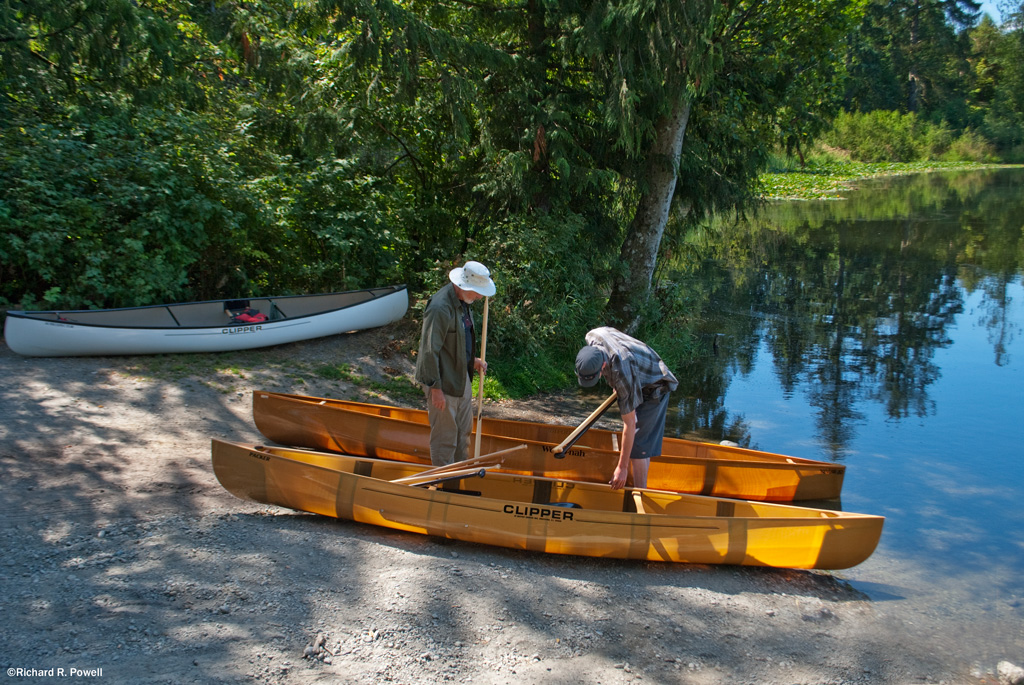
Paul and I met with fellow paddler Greg at Dougan Lake to compare 3 popular solo canoes sold by Abbotsford based Clipper Canoes. Paul brought his Solitude and Betty's Packer, and Greg brought his newly purchased 14 Prospector.

Packer, 14 Prospector, Solitude

The boats measurements look like this:
Solitude 14 Prospector Packer
Length 15 feet 6 inches 14 feet 14 feet
Width at Water Line 30 inches 29 inches 27.5 inches
Width at Gunwales 28 inches 29 inches 24 inches
Bow Height 16 inches 21 inches 16 inches
Centre Height 13 inches 15 inches 13 inches
Stern Height 14 inches 21 inches 16 inches
Rocker Minimal 1.5 inches 1 to 1.5 inches

Clipper also makes two other solo canoes, the Freedom and the Sea-1, and also offers the Prospector 16 and Tripper in solo versions.

14 Prospector and Packer

The Prospector and the Packer are the same length but quite different in design. The Packer is a Gene Jenson creation with a modest (almost straight) shear line, narrow ends, and moderate tumblehome. The Prospector is a James van Nostrand design with traditional ends (fuller and higher than the Packer) a wider beam, and slightly more rocker.

Packer (closer to camera) and Solitude

The Solitude is a longer and slightly wider canoe than either the Prospector or Packer but with very fine ends and a low profile. The Solitude has a modest tumble-home located near the waterline and a pronounced plumb stern which, combined with it's minimal rocker, gives it great tracking. The Solitude's low profile also reduces windage and makes for a sleek, reasonably fast, all around solo canoe.


We brought along an assortment of paddles to try with each boat. Paul had his two bend shaft graphite paddles, two square-tipped Grey Owl paddles (one bent shaft), and his Nashwhack  ottertail. I had my Larry Bowers Cree/Iroquois style single and my Alton Aluet double. Greg had a beautiful Grey Owl "Guide". I hadn't seen one of these higher end Grey Owl paddles and have to say I was impressed with the design and quality. The stunning colour of the cherry wood seemed to match the colours in the Packer extreamly well.

14 Prospector -- agile and maneuverable

The Prospector is an agile and maneuverable solo which is a delight to play in. It responds instantly to even modest paddle strokes and in the kneeling position you can lean out on your paddle and spin the canoe beneath you. It is easy to scull sidways as well as on an angle backwards and forwards. This hull is well suited for investigating nooks and crannies along any shoreline because of it's responsiveness and "turn-on-a-dime" characteristics.

Here is a video of Paul demonstrating how well it maneuvers:


Compared to the Packer the 14 Prospector feels much more spacious. It's more generous ends, higher gunwales, and wider beam all make for a roomy ride. By contrast the Packer feels close and narrow. Notice in the following photo how there is very little extra room between Paul and the gunwales.


Those who don't mind a tighter paddling station may not notice this aspect of the Packer and Greg said he found it to be adequately roomy.


We discussed the capacity of both boats, and while some claim the Packer to be fine for short tripping, I think this applies primarily to the "go light" crowd. The Packer supposedly has 7.3 inches of freeboard loaded to 400 pounds, while the Prospector can take another 200 pounds before reaching the equivalent amount of freeboard. It seems likely then that the Prospector would be much more comfortable on medium to long trips with more gear.

Solitude

The Solitude does not quite match the Prospector's ability to carry a load (The Solitude carries 600 pounds with 7 inches of freeboard)  but the Solitude strikes me as being a more comfortable boat to paddle on long flatwater and mellow river trips. If even minimal whitewater is in the cards, the Packer's extra limited load carrying capacity might be offset by it's versatility, and make it a better choice over the Solitude.

The Solitude, with it's skeg-like stern and minimal rocker tracks well and has a much higher potential speed than either the Packer or the Prospector. But as many of us have concluded this "potential" for speed is seldom achieved by non-athletic paddlers and therefore I would say that for weekend and recreational paddlers shorter boats (12 to 15 feet) with lower surface areas (Packer, Rapidfire, Mist, etc.) give faster acceleration and an easier overall paddling experience.

Solitude

Interestingly I found the slightly narrower and longer blade of Greg's ottertail to work particularly well in the Solitude, even better than my beloved Cree/Iroquois. I practiced the slicing stroke Paul taught me on Buttle Lake and found I could go 5 or more strokes per side in the Solitude without switching or using a correction stroke. It seems to me this combination would allow a paddler to cover a lot of water.

Left -- Solitude, Right -- Packer

On the topic of paddle match for canoe, I found the carbon bent shaft to be better when moving the Prospector across open water and I think it was primarily because of the larger blade surface. It dawned on me why people love their large surface paddles. In canoes like the Prospector that extra "bite" on the water allows you to keep it going in a straight line more easily. Probably any large surface paddle would do, and because the Prospector needs lots of correction in each stroke, a straight shaft might actually be more functional.

14 Prospector

I also tried the Aluet double in the Prospector and it worked reasonably well, but felt less pleasurable than with boats with a more narrow gunwale width. I was pleased to find that this corresponded to my experience in the Solo Plus, also 29 inches at the gunwales. The Prospector seemed even more awkward than the Solo Plus with the double blade because of the higher paddling station (thus further reach to the water) and near lack of tumblehome.

Packer

The Packer responds well to a variety of paddles. Greg seemed at home in the Packer with his ottertail and with the bend shaft carbon. I have enjoyed the Packer with my Aluet double blade, as well as traditional singles.

Discussing Canoes and Paddles

 While all three boats have excellent qualities, of the three my favorite is the Packer.

Packer

It tracks reasonably well, accelerates quickly, and turns and maneuvers easily without the tendency to weathercock or wander. It's low profile means less windage and an easier reach to the water than in the Prospector, and it responds particularily well to shifting balast, making trimming easy.


I also like the look of the Packer, it is understated but clean and smooth. The tumble home is full and comfortable if lacking the sexiness of the Solitude and similar newer designs.

Dancing in the 14 Prospector

It is hard to beat the traditional look of the Prospector, but for me, the extra sail created by those classic ends is not worth their aesthetic value. Still, that elegant shearline is a pleasure to gaze upon.

14 Prospector

Also, for me, the extra capacity and maneuverability of the Prospector are features I would seldom take advantage of. The Packer has been outfitted by Clipper for some customers as river boats, but it seems to me that those fine lines, reflecting the designers love of racing, preclude it from serious whitewater.

Prospector (left) and Packer

At the End of the Day


14 Prospector -- Highly maneuverable solo best suited to the paddler wanting to take longer trips with lots of gear and a likely to encounter a variety of types of water (whitewater, rivers, flatwater). Challenging to keep going in a straight line, especially in wind and slower top end speed than the other boats tested.

Solitude -- Straight as an arrow flatwater cruiser. Well adapted to hit and switch with an ottertail or bent shaft single. Suited for tripping on lakes and easy rivers. Stable and comfortable for photography.

Packer -- Versatile and lively all around solo able to handle flatwater and some whitewater but best suited to lakes and easy rivers. Because of the superb way this hull managers to allow both reasonable tracking and good turning, I rank this canoe as the best match of the three tested hulls for Vancouver Island freshwater paddlers.