Returning from a trip to the Cowichan Valley in January for some misty morning photography, I stopped to check out Chemainus Lake. The last time I had been there was years earlier, and it had, at that time, felt sad and overused. This time, however, I found a new robust dock, excellent roadway, and fresh gravel at the put-in. I thought, "Time to bring the canoe."
So, on the last day of March, I got up early, canoe already on the roof, and head south. I arrived while it was still dark, put the canoe in the water and set out onto the little lake amid a rising mist and almost total silence.
I paddled around in the cold pre-dawn light, watching the mist swirl and listening to the birds waking up and becoming active. That time of day, on a small body of water, is perhaps the best time of all. The feeling of positive aloneness (sabi) and the feeling of connection to the natural world work to create a rich sense of contentment and hushed awe.
I drifted around, watching the sun slowly rise, painting the tree tops first, with it's golden glow, then eventually the mist, which became thicker with the change in temperature.
I surrendered to the beauty, feeling the cares of the week drifting away amid the mist. There is something about this kind of beauty, the majesty of it, the power of it, that creates an especially receptive mind. I thought about work, relationships, harmony and discord. A wetland is a place that mirrors these qualities. So much life, and with it, so much death.
I experimented with my new camera and the even newer vintage Pentax 28mm lens. It is always difficult to capture the scale of a place like this. Chemainus Lake is small, but also packed with endless views, sights, and details. There are so many nooks and gaps in a wetland and in fact this little lake has channels between the main lake and the shore, bands of water that curve around behind reed banks and a beaver store.
Then, the sun broke over the trees and the morning began in earnest. This always causes me a bit of excitement, the golden hour has begun! I race to get photos, everywhere I look a new subject, a new breath-taking image.
The first shots were of the reed banks, as the light broke across them. I paddled to two spots of the lake to get different perspectives.
As I did, the nesting geese started honking, and within minutes a flock of new geese arrived.
In the reeds, marsh wrens and song sparrows started to mill about, joined by red-wing blackbirds going from perch to perch and back again. The morning chorus, or racket, had begun.
Song Sparrow
Male Redwing Blackbird
Female Redwing Blackbird
Resident Nesting Canadian Goose
About that time, a paddling fly angler joined us on the water. I was off in a corner with my long lens, trying to get portraits of some of the smaller residents, but I snapped one of this young fellow. We humans tend to dominate the landscape, with our impressive tools, including tackle and vessel.
Young Male Human
Another angler arrived on the dock, so I headed down to the far end of the lake. Along the way I marveled at the beauty of this little spot. The shoreline from the water is truly stunning.
As more humans came onto the water the non-resident geese took flight to the air, and I retreated further into the reeds.
Canadian Geese Take Flight
My Hideout Amid the Reeds
In a shady corner I took out my other new vintage lens, the Revuenon 55mm 1.2. This bokeh master lens creates unique artistic renditions that, in some ways, capture a place better than razor sharpness ever can.
By that time, there were anglers arriving every few minutes. I waited against the reeds near the dock as two young fellows in kayaks, a woman in a float tube, and two older guys in a tinner made there way out. I took a photo of the men with kids on the dock. "Can I touch it?" came the call of one child as a fish was held out flopping for inspection. The curiosity and excitement in the kid's voices was a welcomed sound.
Men and Boys Enjoy the Sturdy Functional Attractive Dock
I was glad that these folks would enjoy their time, AND was also glad I was leaving. I packed up while another fellow prepared to head onto the water in a pontoon boat. I would be back to take more photos on this fantastic jewel of a lake on this special island.
It has been 4 years since my last post. Maybe I'm taking this Kanjaku thing a little too far? Well, with my new canoe, and camera, and Wanda I headed north for our summer vacation. We stayed at the most excellent Cluxewe Resort and Campground in cabin #3. Excellent. Right on the beach. But I digress.
Sara Lake is a little lake a stones throw from the "Eastern tip" of Marble River Provincial Park. Most people going to the park are looking to kayak or canoe the ocean. Sara Lake is overlooked. But not by us.
I had scouted out places to paddle the day before and was delighted to find that some good soul had cut away the two large trees that previously has blocked access to the put in. The trail from the road is root-bound but easy to navigate and takes about 2 minutes to traverse. The put in is a typical muddy-bottom shallow space beside a small grounded - well what would you call it - raft? Not really a dock. But Wanda was able to get in without getting her feet wet.
On the water it is a short paddle to the two sheltered bays surrounded by lush water plants and Sweet Gale. We idled in and out of these bays, enjoying watching the thousands of tadpoles cruising along the copper coloured bottom in the shallows. White and black winged dragon flies rattled past us and we observed a dragon fly larva eating a tadpole. Then we watched a loon dive for fish.
A small beautiful piece of nature and calm which probably sees few visitors. A shame really, because it is a great place to while away a few hours.
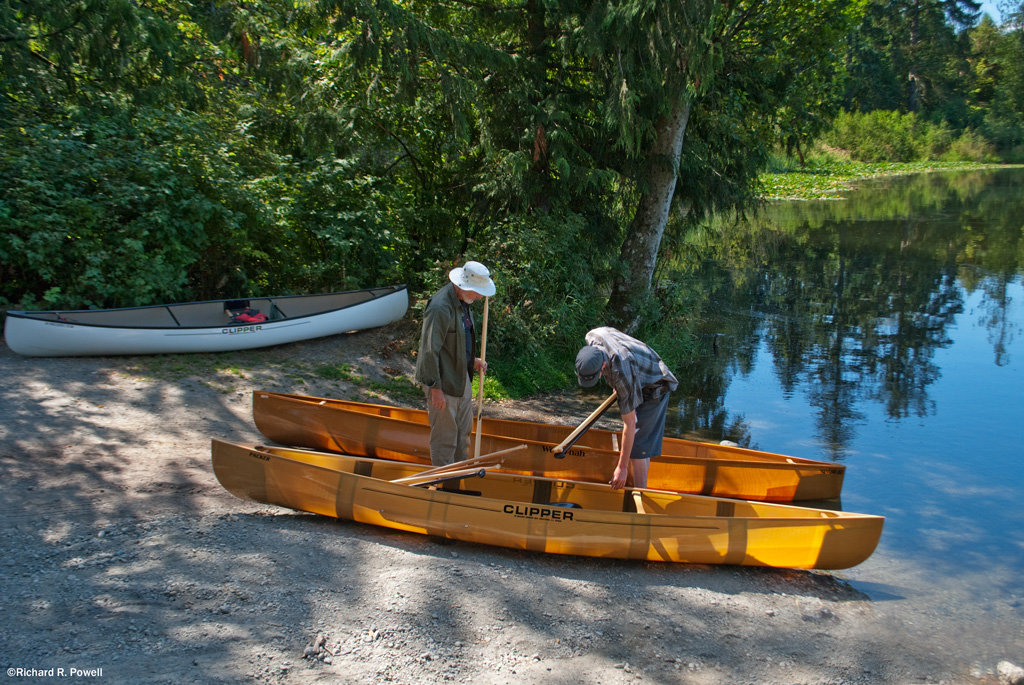
Paul and I met with fellow paddler Greg at Dougan Lake to compare 3 popular solo canoes sold by Abbotsford based Clipper Canoes. Paul brought his Solitude and Betty's Packer, and Greg brought his newly purchased 14 Prospector.
Packer, 14 Prospector, Solitude
The boats measurements look like this:
Solitude
14 Prospector
Packer
Length
15 feet 6 inches
14 feet
14 feet
Width at Water Line
30 inches
29 inches
27.5 inches
Width at Gunwales
28 inches
29 inches
24 inches
Bow Height
16 inches
21 inches
16 inches
Centre Height
13 inches
15 inches
13 inches
Stern Height
14 inches
21 inches
16 inches
Rocker
Minimal
1.5 inches
1 to 1.5 inches
Clipper also makes two other solo canoes, the Freedom and the Sea-1, and also offers the Prospector 16 and Tripper in solo versions.
14 Prospector and Packer
The Prospector and the Packer are the same length but quite different in design. The Packer is a Gene Jenson creation with a modest (almost straight) shear line, narrow ends, and moderate tumblehome. The Prospector is a James van Nostrand design with traditional ends (fuller and higher than the Packer) a wider beam, and slightly more rocker.
Packer (closer to camera) and Solitude
The Solitude is a longer and slightly wider canoe than either the Prospector or Packer but with very fine ends and a low profile. The Solitude has a modest tumble-home located near the waterline and a pronounced plumb stern which, combined with it's minimal rocker, gives it great tracking. The Solitude's low profile also reduces windage and makes for a sleek, reasonably fast, all around solo canoe.
We brought along an assortment of paddles to try with each boat. Paul had his two bend shaft graphite paddles, two square-tipped Grey Owl paddles (one bent shaft), and his Nashwhack ottertail. I had my Larry Bowers Cree/Iroquois style single and my Alton Aluet double. Greg had a beautiful Grey Owl "Guide". I hadn't seen one of these higher end Grey Owl paddles and have to say I was impressed with the design and quality. The stunning colour of the cherry wood seemed to match the colours in the Packer extreamly well.
14 Prospector -- agile and maneuverable
The Prospector is an agile and maneuverable solo which is a delight to play in. It responds instantly to even modest paddle strokes and in the kneeling position you can lean out on your paddle and spin the canoe beneath you. It is easy to scull sidways as well as on an angle backwards and forwards. This hull is well suited for investigating nooks and crannies along any shoreline because of it's responsiveness and "turn-on-a-dime" characteristics.
Here is a video of Paul demonstrating how well it maneuvers:
Compared to the Packer the 14 Prospector feels much more spacious. It's more generous ends, higher gunwales, and wider beam all make for a roomy ride. By contrast the Packer feels close and narrow. Notice in the following photo how there is very little extra room between Paul and the gunwales.
Those who don't mind a tighter paddling station may not notice this aspect of the Packer and Greg said he found it to be adequately roomy.
We discussed the capacity of both boats, and while some claim the Packer to be fine for short tripping, I think this applies primarily to the "go light" crowd. The Packer supposedly has 7.3 inches of freeboard loaded to 400 pounds, while the Prospector can take another 200 pounds before reaching the equivalent amount of freeboard. It seems likely then that the Prospector would be much more comfortable on medium to long trips with more gear.
Solitude
The Solitude does not quite match the Prospector's ability to carry a load (The Solitude carries 600 pounds with 7 inches of freeboard) but the Solitude strikes me as being a more comfortable boat to paddle on long flatwater and mellow river trips. If even minimal whitewater is in the cards, the Packer's extra limited load carrying capacity might be offset by it's versatility, and make it a better choice over the Solitude.
The Solitude, with it's skeg-like stern and minimal rocker tracks well and has a much higher potential speed than either the Packer or the Prospector. But as many of us have concluded this "potential" for speed is seldom achieved by non-athletic paddlers and therefore I would say that for weekend and recreational paddlers shorter boats (12 to 15 feet) with lower surface areas (Packer, Rapidfire, Mist, etc.) give faster acceleration and an easier overall paddling experience.
Solitude
Interestingly I found the slightly narrower and longer blade of Greg's ottertail to work particularly well in the Solitude, even better than my beloved Cree/Iroquois. I practiced the slicing stroke Paul taught me on Buttle Lake and found I could go 5 or more strokes per side in the Solitude without switching or using a correction stroke. It seems to me this combination would allow a paddler to cover a lot of water.
Left -- Solitude, Right -- Packer
On the topic of paddle match for canoe, I found the carbon bent shaft to be better when moving the Prospector across open water and I think it was primarily because of the larger blade surface. It dawned on me why people love their large surface paddles. In canoes like the Prospector that extra "bite" on the water allows you to keep it going in a straight line more easily. Probably any large surface paddle would do, and because the Prospector needs lots of correction in each stroke, a straight shaft might actually be more functional.
14 Prospector
I also tried the Aluet double in the Prospector and it worked reasonably well, but felt less pleasurable than with boats with a more narrow gunwale width. I was pleased to find that this corresponded to my experience in the Solo Plus, also 29 inches at the gunwales. The Prospector seemed even more awkward than the Solo Plus with the double blade because of the higher paddling station (thus further reach to the water) and near lack of tumblehome.
Packer
The Packer responds well to a variety of paddles. Greg seemed at home in the Packer with his ottertail and with the bend shaft carbon. I have enjoyed the Packer with my Aluet double blade, as well as traditional singles.
Discussing Canoes and Paddles
While all three boats have excellent qualities, of the three my favorite is the Packer.
Packer
It tracks reasonably well, accelerates quickly, and turns and maneuvers easily without the tendency to weathercock or wander. It's low profile means less windage and an easier reach to the water than in the Prospector, and it responds particularily well to shifting balast, making trimming easy.
I also like the look of the Packer, it is understated but clean and smooth. The tumble home is full and comfortable if lacking the sexiness of the Solitude and similar newer designs.
Dancing in the 14 Prospector
It is hard to beat the traditional look of the Prospector, but for me, the extra sail created by those classic ends is not worth their aesthetic value. Still, that elegant shearline is a pleasure to gaze upon.
14 Prospector
Also, for me, the extra capacity and maneuverability of the Prospector are features I would seldom take advantage of. The Packer has been outfitted by Clipper for some customers as river boats, but it seems to me that those fine lines, reflecting the designers love of racing, preclude it from serious whitewater.
Prospector (left) and Packer
At the End of the Day
14 Prospector -- Highly maneuverable solo best suited to the paddler wanting to take longer trips with lots of gear and a likely to encounter a variety of types of water (whitewater, rivers, flatwater). Challenging to keep going in a straight line, especially in wind and slower top end speed than the other boats tested.
Solitude -- Straight as an arrow flatwater cruiser. Well adapted to hit and switch with an ottertail or bent shaft single. Suited for tripping on lakes and easy rivers. Stable and comfortable for photography.
Packer -- Versatile and lively all around solo able to handle flatwater and some whitewater but best suited to lakes and easy rivers. Because of the superb way this hull managers to allow both reasonable tracking and good turning, I rank this canoe as the best match of the three tested hulls for Vancouver Island freshwater paddlers.




 Posts
Posts


