Sunday, 9 August 2009

100 Lakes Visited

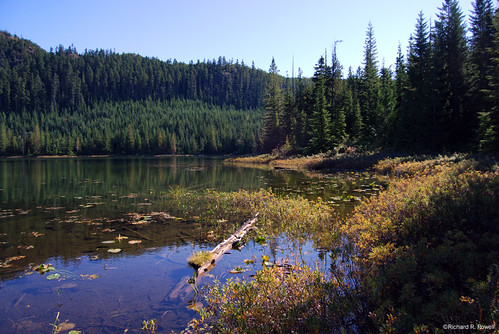
Bear Lake

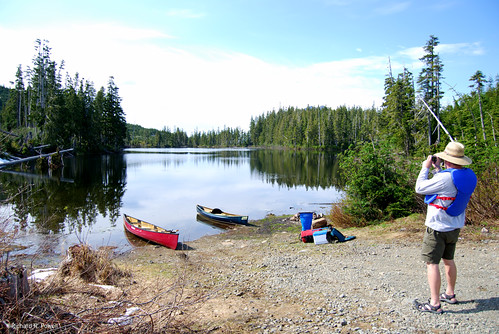
Yesterday I visited the 100th Lake in my exploration of lakes on Vancouver Island. Of those 100 lakes visited I paddled 54, some more than once (Trail Pond, Turtle Lake, Mohun Lake, Bear Lake, Somenos Marsh, and Westwood Lake).

The reasons for not paddling 46 of the 100 were varied. Some had no easy access, or the lakes did not look interesting, or I didn't have sufficient time to paddle the lake on the day I was there, or I ended up paddling somewhere better.

I have posted a list of both the lakes visited and the lakes paddled so far here: http://www.stillinthestream.com/files/lakesvisited.html

Of the lakes visited but not paddled, I plan to paddle 24, but only 10 are high on my list. I still have about 30 other lakes to investigate first. I expect to paddle another half dozen before 2009 comes to an end.

Of the 54 lakes paddled so far only a handful were less enjoyable than I expected before visiting them, and only three actually disappointed me (Cedar Lake, Hawthorn Lake, and Darkis Lake). Some others such as Dougan and Echo Lakes turned out to be prettier to look at from the highway than to paddle on (and both suffered from excessive traffic noise).

Afew turned out to be more rewarding than I expected. Anutz and nearby Atluck Lake both overwhelmed me with their interesting shorelines and scenery while Spirit and Grace lakes provided a sense of remoteness and peacefulness that was out of proportion to their setting. Subtle beauty and a satisfyingly untouched quality seem to be the reason for these shallow quiet lakes charm.

Grace Lake

Some urban lakes turned out to have surprisingly natural shorelines (Thetis Lake and Westwood Lake) while some wild lakes suffered from overuse as evidenced by severely trampled and eroded shorelines (Spectacle, Peak, and Twin Lake).

Peak Lake

I have learned how much water level can effect the feel of a lake. Somenos Lake dropped 4 or 5 feet over a few months changing the paddling experience significantly, and the exposed beaches of Buttle, Elsie, Darkis, and Klaklakama Lakes detract from otherwise promising locations.

Some of the jewels of the island felt vulnerable and fragile. Mohun and Amor lakes are world class paddling destinations yet active logging throughout the Sayward Forest threatens to reduce the recreational value significantly. Many areas are closed for logging and I will be returning after the fact to see what is left. This whole area should be protected for posterity now. While the logging that is going on is responsible, it's just too pretty an area to scar with clear cuts.

Mohun Lake

Other gems, like the swamps and lakes of the Stamp and Ash valleys are on private land and at the mercy of the giant forest companies who own them.

Moran Swamp

Pat Bell, minister of forest and range, said in response to recent questions about the status of large trees on Vancouver Island that sufficient old growth is already protected - the rest is free to be logged. This comment reinforces his January declaration that the old growth ecosystem is amply protected. Mr. Bell sees no reason to protect more forest from the saws. I do.

I witnessed in July of this year one logging truck on the Cowichan Highway (Hwy 18) with three massive tree trunks filling it's trailer. These are very large old-growth trees, and the loggers are obviously active in our woods getting every last one.

I need to learn more about the BC government system and discover if it is possible to bring the aesthetic quality of our wetlands and forest into focus before it is too late. How can such beauty be destroyed for the profit of so few when if they are protected they can benefit so many for so many years to come?

Surely money isn't the only abstract construct that can be extracted from these locations. Should poetry, tranquility, and the healing power of nature feature in my writing? A lake without a large clear cut beside it is significantly more attractive than a lake with a tiny ribbon of trees between it and the surrounding expanses of dead stumps, slash, and torn up soil. Will it help to paint this picture? Can my writing and photography have any effect?

Sunday, 2 August 2009

Hand Made Paddles

James and I stand in the airy workshop of Larry Bowers. Around us are the hulls of canoes Larry is building, in various states of completion. There is a sweet smell of wood and varnish. Larry takes from the wall several patterns for canoe paddles and we ask him about the advantages of each. He shares stories about a few of the paddles he has made. We look at and hold a few of his favourites. Paddles, even more than canoes, connect us to water. Beautiful paddles connect us to something deeper.

James has done his research. He laid out his findings to me on the drive from Nanaimo to Campbell River where Larry lives and runs his business. James is keen on a traditional Algonquin blade pattern and his reasoning is this: the Algonquin blade has a slightly narrowed and rounded tip, allowing a clean entry to the water with less friction than other designs. Between a ½ and ¾ of the way up the blade it widens slightly before tapering back to the shaft. The advantage of this shape is that when the blade is drawn back from that initial entry and submerged fully beside the canoe the wider section of the blade engages at a point where the arms have their greatest leverage, putting the maximum blade surface in the water during the most powerful portion of the stroke.

It is a logical and persuasive argument and as we stand looking at the templates we listen to Larry tell of the two paddles he has favoured over the years. One of them is very close to the shape of the Algonquin blade. Both James and I decide to order this blade shape from Larry. But I am also attracted to an unusual shaped blade that Larry describes as a Cree design. He tells us that he used the template to build a paddle once but that he rounded the tip more, moving the shape from an exaggerated “tip-heavy” design to a more beavertail-style tip. It turned out to be a good one.

Unlike a standard beaver tail, this “Larry Bowers” custom shape (on the left in the picture above) has the long straight sides of the Cree style with the pleasing tip of the beavertail. I decide on this blade shape for my second paddle. It seems to defy the logic associated with the Algonquin blade, and while my rational mind is warning me to reconsider the choice I have a strong intuition telling me there is something right about the shape. I wonder if I am being drawn in by the novelty of it or maybe it’s aesthetics, but secretly hope there something I don’t know yet about this design that makes it a winner.

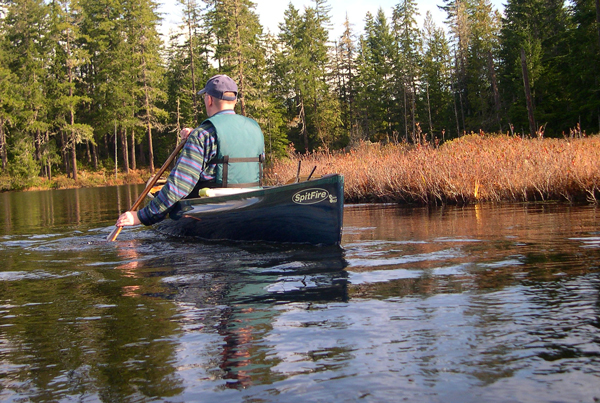
Next we talk about shaft length. I produce from the vehicle an old cheap beavertail paddle which I inherited from my father and found to be just the right length for the low paddling station of my Placid Boatwork made Spirtfire pack canoe. For the Algonquin blade I request the shorter shaft length creating a 58 inch paddle with 25 inches of shaft and 27 inches of blade, 3 inches of throat, and 3 inches of grip. I learn later that this is a very close to the average for historical paddles that Doug Ingram reports in his online article, Historic Paddle Reproductions (http://www.redrivercanoe.ca/Historic%20Paddles.htm).

I order the Cree blade in the dimensions that Larry recommends, trusting this craftsman’s experience and familiarity with the material. At 59 and ½ inches it will be longer than any of my other single blade paddles and I plan to use it primarily with the Solo+.

John Bell of Red Tail Paddles states, “Probably 90% of all adults can use a 54 inch paddle with a 20 inch blade,” though Bell does make paddles up to 63 inches long. His comment worries me, causing me to wonder if the Cree paddle will be too long, but then when I browse pictures of old voyageurs in their canoes and recovering from the day’s paddling in their 19th century camps, I notice how long and thin their paddles are. The voyageurs used various lengths of paddles but almost all of them had thin blades because they paddled hard and fast. Such hard fast paddling put tremendous strain on the paddles and ones made of spruce, though light, broke often. Therefore the Voyageurs chose hardwoods for their paddles, and made many of them, often on route.

The paddles Larry makes for us are a combination of spruce and yew (Spruce on the left above, and Yew on the right). The spruce is Sitka Spruce, a clear springy wood from the noble giants made famous on Vancouver Island as part of the sky garden ecosystem studied in the Carmanah Canopy Project.

The Sitka Spruce tree grows with a very straight trunk and is one of the tallest on the coast, only surpassed by the Douglas Fir and Western Hemlock. The light straight grained wood is used for everything from guitars to boats and contains pleasing mottling where the wood is rounded. The yew wood used in our paddles has a pedigree.

Sometime before his death in 1944 my grandfather strode into a forest near Nelson and cut down some yew trees. As a woodworker raising a family through the great depression he made a wide assortment of wooden objects for people, from cabinets to houses. The Yew he prized for rifle stocks. Two pieces of yew were carefully dried and stored for future use. The years passed and my father inherited the wood and stored it in our woodshed where I saw it from time to time while growing up. When my parents moved to a smaller house upon retirement the yew wood passed on to me. It sat in my woodshed for another 10 years.

Larry explains to us that he regularly uses the hard and durable yew wood laminated onto spruce to create a resilient and responsive paddle. Larry demonstrates by leaning hard on his own laminated spruce and yew paddle so that the paddle bends dramatically and springs back. Yew was a choice wood for archery bows for centuries and is still used today for this function.

A few months after we placed our order Larry calls to tell us the paddles are ready. We head to Campbell River to pick them up. They are beautiful hanging in his shop and I can’t help grinning as we examine their beautiful smooth surfaces and deep natural colors.

After chatting with Larry for awhile we stop only briefly for cheesecake at Cheescake 101 a short distance from Larry’s shop, before beetling out to Echo Lake to try out the new paddles. Larry has also given us to try a paddle he just made for himself, along with a much shorter paddle that James spied in Larry’s shop.

On the water I notice immediately that the paddles feel too long for the pack canoes, but a curious thing happens. The very long Cree style paddle has an interesting quality. Trying to lift the long blade clear of the water proves to be a little awkward but keeping the blade in the water and knifing it forward in an Indian stroke is enjoyable and effective. The power in the correction is impressive as the long blade rises almost vertically at the end of the power stroke before slicing forward for the next stroke.

I look over at James and notice that he is trying different holds on Larry’s paddle, abandoning the high grip and grasping the paddle at varying heights along the shaft.

I switch to the shorter Algonquin blade that I had designed specifically for this boat and appreciate immediately the familiar shaft length from my Dad’s old paddle. Interestingly, however, the paddle does not function as well on the Canadian stroke. I adjust myself accordingly and find the Indian stroke works extremely well with this paddle. James passes off Larry’s paddle to me and I pass over my paddle with the shaft length 3 inches shorter than his. He tries them both and decides that for his Rapidfire a shaft length somewhere in the middle would be perfect.

The following weekend I take my Wenonah Solo+ to Westwood Lake, the water jammed to overflowing with Nanaimoites seeking relief from the 37 degree summer hot spell. I paddle to the far end of the lake, trying my two new paddles and comparing them with my shorter Redtail Ottertail as I go.

The Redtail is 53 and ½ inches long, a full 6 inches shorter than my new Larry Bowers Cree, and a mere ½ inch shorter than John Bell’s recommended average. The Redtail Ottertail and the new Algonquin are almost identical in blade shape, the Algonquin blade being about 3 and ½ inches longer with a ½ inch longer neck transition. They perform similarly, but the slightly longer blade on the Algonquin gives a notably better grip on the water, and the bobbled grip allows me to spin the paddle effortlessly while performing the Indian stroke.

The Cree surprises me by feeling less substantial than the Algonquin in the Solo+ and I compare the blade shapes and discover that while they are identical in length, the Algonquin is wider in the middle. This slight difference is noticeable on an extended paddle around the lake. Both blades whistle nicely on the forward underwater slice and the do not seem to resist as much as the Redtail.

Sure enough, on examining the blade edges Larry’s paddles are more knife-like at the edges and the blades are noticeably thinner. I spend about an hour sculling and testing pries, jams, and reverse sculls. For all these actions the Cree style is superior, though challengingly exact in a bow jam, perhaps because of the long length and the Solo Plus’ minimally rockered hull and sharp entry lines.

I find a private bay on the south western end of the lake and practice maneuvering between the many deadheads and dead trees there. The limitations of the Solo+ in such situations becomes apparent. This straight tracking canoe with it’s excellent secondary stability is not easy to spin, even when heeled.

The surprises of the paddles and my continuing curiosity over the blade shapes drive me to research. I get the best book I can find on the subject out of the library — Graham Warren and David Gidmark’s Canoe Paddles: A Complete Guide to Making Your Own. On page 12 of this detailed and informative work I see a diagram of a Passamaquoddy paddle which is very close to the “Cree” design Larry showed us. On the same page the Algonquin shape is clearly illustrated. The Cree paddle diagram on the page is similar, but has a clear transition at the neck, but on the next page is a Western Cree paddle that has less of a distinct transition. I study the drawings in detail and decide that Larry’s design in a cross between the Passamaquoddy and the Cree. It has the long blade and straight taper of the Cree, with the smooth neck of the Passamaquoddy.

A few days later I am browsing Bark Canoes: The Art and Obsession of Tappan Adney by John Jennings, when I come across, on page 80, a paddle blade that almost exactly matches the design. It is an Iroquois paddle (pictured above). Later in the same book, page 127, is another paddle that looks similar leaning against an Ojibway Style Tetes de Boule canoe that Abney found in Grand Piles Quebec in 1925. (see below)

Warren and Gidmark put Iroquois blades in three catagories: Beavertail, Elongated beavertail, and Straight-sided rounded. Ojibiway paddles turn up under Elongated beavertail and Straight-sided rounded, as well as Ottertail.

Of the 10 basic categories Warren and Gidmark sort all historic blades into, 5 have the widest part of the blade near the middle of the blade, 2 have the widest part near the neck, and 3 have the widest part near the tip. Clearly the majority of blade shapes from indigenous tribes of North America place the widest part of the blade near the middle to take advantage of the mechanics James had described to me earlier.

I finally decide that the 9th category most closely fits my Cree style blade, what Warren and Gidmark call the “Straight-sided, rounded” blade.

A search online of the major paddle manufacturers reveals that most produce a version of the Ottertail, Beaver Tail, Elongated Beaver Tail, or the contemporary White water paddle (large surface square bottom). One company, Shaw and Tenney, has a paddle they call the Racine. They explain that it is a replication of a paddle originally sold by the Racine Canoe Company of Wisconsin. The paddle was offered with the sale of each Racine Canoe Company wood/canvas canoe sold until the company went out of business in the 1920’s. Shaw and Tenney report that the Racine is becoming their best selling paddle with many repeat orders. They claim that it is a very quiet paddle, and, because the blade is only 5” wide, lends itself well to the North Woods stroke as well as to solo paddling. The Racine is available in the two original lengths, 58-1/2" and 63-1/2", which they say seem to work perfectly for everyone.

I can find no other paddle on the market that matches the profile of Larry's Cree design. Even the Racine is closer to the Algonquin design with its very slightly tapering tip. Interestingly the majority of traditional wooden paddle builders (Turtle, Kettelwell, Redtail, Greyowl, and Shaw and Tenney) sell version of the Ottertail or Algonquin, usually with a Beavertail or two to round out the selection. A few, such as the noteworthy Whiskyjack, almost exclusively produce modified white water blades. Still others such as Anderson, Carlisle, Cricket, Foxworx, and Sawyer, produce beefy versions of the ottertail and Algonquin along with a plethora of square bottomed whitewater styles.

Beefy blades with areas larger than 140 square inches are generally recommended for short tripping, white water, and sprint racing, as well as dragon boating and stand up paddle boarding. The larger area provides greater thrust. Thrust is proportional to blade area according to Warren and Gidmark (blade area x (stroke rate)2 and sustainable stroke rate is proportional to 1/(blade area). Stroke rate has a greater effect than blade area does because its contribution is squared. Aspect ratio is another important factor in beefy blades. Short fat blades exhibit more drag than long narrow ones of the same surface area. So in effect you get more bang for your buck with a short fat blade. Shorter blades are also easier to handle when the blade is lifted out of the water while paddling or when switching sides. But short fat blades have a few drawbacks. Firstly they are more difficult to keep close to the hull when paddling and secondly they splash more on entry. Also they flutter more when doing a below water slice and tend to catch and veer more in the hands of a novice.

The lower aspect paddles, on the other hand, while providing less overall drag, go deeper into denser water, slice better, and enter the water with less splash. Low aspect paddles are longer, and therefore less effective in shallow water but more effective for long reaching braces. A low aspect paddle with a blade that concentrates more area farther away from the paddler’s fulcrum (like my Cree style paddle does) provides more leverage making it better for sculling and steering. Doug Ingram of Red River Canoe & Paddle is a paddle builder who helped clarify for me the great diversity in Paddle blades. Ingram produces the widest range of blade shapes on the market and his Cree replica convinced me that Larry was, not surprisingly, right to call my paddle a Cree design.

Ingram writing about historic North American paddles says, “Amongst the many different blade shapes that have been conceived, traditional blades can be loosely categorized as being either straight-sided or round-sided. Surface areas are concentrated near the throat, evenly along the length, or near the tip. Tips are pointed, rounded, or blunt. I began to wonder what, then, are the constants of these traditional designs. Blade length varies, but averages in the 27- to 30-inch range. Width also varies, but blades are rarely wider than 6 inches.” Ingram’s conclusions were that trial and error sifted out the lengths and blade shapes that survived.

Ventilation seems to be an important factor in this sifting process. Large blades with abrupt transitions at the throat allow air to enter behind the paddle, making them inefficient if paddled too quickly. The other factor that creates ventilation is when the blade is not fully immersed in the water. The short fat blades lose most of their aspect ratio advantage if the blades are not fully immersed while paddling.

Straight Stick

Intuition and time on the water teaches most people this lesson, and I notice when teaching new paddlers that I often have to encourage them to get their blade hand close to or in the water. This advice does two things. It fully immerses the paddle blade and lowers the paddle overall, bringing the grip hand lower as well. Many photos of people paddling, including two of the 4 pictures on the inside cover of the instruction booklet that comes with every Wenonah canoe, show paddlers with their grip hand high in the air, sometimes over their heads!


The optimal position advocated by many instructors is to have the grip hand move in an area between the shoulder and the lower ribs. Never higher than the chin. Doug Ingram introduced me to several helpful ideas in his article. Most important was his description of the “Northwoods Stoke” which seems to be a modified Canadian stroke that keeps both arms low to the gunwales. The lower the arms, the less energy is used holding them and the paddle in the air.

I now finally understand the purpose of the large grips on so many traditional paddles. The way of holding the paddle grip in the Northwoods Stroke had never occurred to me but I plan on experimenting with it in the future.

There is not a lot of information out about the Northwoods Stroke online but Ingram’s own photos are clear, and several helpful discussions exist on various forums about the style. Another idea introduce to me in Ingram’s article is that of the round Cree grip. This is perhaps the best article on the internet about historic paddles. I encourage you to read the whole piece at

http://www.redrivercanoe.ca/Historic%20Paddles.htm

For additional images of my new paddles go to the photo album: http://www.stillinthestream.com/files/Paddles/index.html

Westwood Lake at Sunset

Thursday, 23 July 2009

Aesthetic Value is as Important as Economic Value

On my travels around Vancouver Island I see first hand the ugly impact of logging on our own rainforests. I'm not against responsible logging, but we have to leave larger areas of old growth to preserve the genetic diversity and aesthetic value that used to dominate this island.

I wonder if people realize how much beauty has already been lost. It is staggering. Almost all the lakes I visit have ugly logged sections around them. It takes 300 years to grow a mature forest. We are not going to see them again in our lifetime, so we should think seriously about how much we cut down. Aesthetic value needs to be recognized along with economic value.

If you walk in an old growth forest, or paddle beside one, it changes you, and if you plant and protect more forests, they can save the world. Where are BC's environmental laws? Almost non-existant. If our government won't respond to this urgent need, we need to look elsewhere. Here is a way you can help:

Thursday, 2 July 2009

Anutz Lake

Vancouver Island Backroad Mapbook - Map 36 D1
Atlas of Canada Link: Anutz Lake
Latitude and Longitude: 50o 17' 59" N - 126o 55' 0" W

Trip Date: June 21st, 2009


I arrive late Sunday afternoon, wind blowing straight at the beach, sun bleaching the view. An assortment of robins work the Thimble Berry and Pacific Ninebark bushes. No one is at the site but there are deep ATV ruts along the beach and in the middle of the field, a circle where an ATV went around and around. It feels a bit like a ghost town.

I decide to camp close behind the row of bushes that separate the beach from the campsites.
I cook dinner, read for awhile, then explore the beach to the west and discover a place where water has created a flow of limestone out from a small opening in the rock — a white tongue of stone. I climb up onto a 14 foot high rock outcropping and watch the waves, listen to the wind in the forest.
Red Paintbrush shocks from side to side in the wind. I scramble down onto some lower rocks worn by water, the waves making hollow gurgling sounds below my feet somewhere under the rock.
Then around the corner I find a sculpted stone with a hole right through the middle.
I explore the forest; find a trail that leads back to the campsites through a nice mature second growth woodland, stopping briefly to admire a patch of Pacific Lilly of the Valley.
Still no-one at the campsite when I break out of the forest into the open field. The 10,000 clusters of Pacific Ninebark blossoms bob at the margin of the meadow, Yellow Salmon Berriers, gone pink where eaten by some animal shine in the growing dark.
I photograph a Nootka Rose and examine the berries forming on a twinberry bush, the woundlike bracts somehow disquieting my mind when I look at them up close. I crane my neck to look at mares tails in the sky, listen to a bird call I don’t recognize, the sound like a child’s toy whistle, a single rising note, as if questioning, tentatively, the coming night.
I accept that the wind is not letting up tonight, return to my camp, try to read but the noseeums find me. I put on bug spray. A male grouse thumps his call, almost too low to hear, while the robins give up their evening melodies to a scattered ramble of chirps. Sky goes pink, then a few puffy clouds are left, orange around the edges.
Then the silence after climbing into my sleeping bag inside my tent. I fall asleep sometime after 10:30, wake after midnight chilled and pull on my sweater, the tips of the trees out the tent window are still against the dark grey sky. The night never gets completely dark in June. At 3:00 I wake and listen to the grouse call, It is the only sound in the darkness. At 6:00 I scramble out of the tent and walk to the beach. The sun is just lighting up the peaks of the Karmutzen Range (Nimpkish Lake was named Karutzen lake for awhile) and a mist is rising from the lake.
I hurry back, put my down vest over my wool sweater, then the PFD, pulling on my paddling boots and gortex pants. I take down my canoe, load up some food and other supplies and am on the water in a few minutes, paddling towards the western area where two creeks empty into a marshy estuary.
Fish that have been lolling at the surface break away from me in the early light and disappear amid the Lilly pads.
The current moves in swirls between the floating pads and I can see that a beaver has been at work attempting to bridge the entire estuary with a low dam. I find an opening and push through.
There turn out to be three inflows; all but one shrouded with sedges and rushes and the middle one has a curious feature. A log is wedged between the banks, forming a natural dam so that the water on the other side of the log is several feet higher than where I float in my canoe. There is a deep hollow sound of water like the sound of a bathtub filling as the water flows from beneath the log into a collection of smaller debri and I wonder how long this tiny cascade will exist. I listen to it for awhile before exploring some of the floating gardens growing on the ends of a half submerged logs. Yellow Monkey Flowers bob over the water along side Fire weed and gracefully curving sedges, each blade pointed with a shinning drop of dew.
I turn and paddle down the western shore towards the river that connects Anutz and Nimpkish Lake. Stickleback cruse in the shallow water along the river banks, a king fisher skims the surface going past fast, his flight arch taking him sharply up to light on a tree branch, scold me, then head off down river. The current picks up over the shallow bars of gravel, then deep clear pools green towards the stony bottom. Widgeon grass sways like the skirts of a Hawaiian dancer as I go around a corner and under an overhanging tree.
I pass two side channels which I know are oxbows from examining the area on Google Earth. Then the final long stretch and the narrowing just before Nimpkish Lake, where the old pilings are. I drift out into the lake on the current, paddle to shore and stroll the beach, eating a granola bar and drinking some water.

The sun crests over the mountain but only flashes briefly before disappearing behind clouds; there is a tiny riffle far out on Nimpkish Lake. I take off my down vest and drink some more water.
The paddle back upriver is slower, working only slightly harder against the current. Robins, always lots of robins, call in the salal and I turn in at the first oxbow to listen to them. There is a family of mergansers, the young fledglings lanky and shy, and as I drift towards them the hen takes flight, the ducklings disappear under the brown surface like skin divers. I turn around and head back, but some of the ducklings have surfaced behind me, lurking under the edges of Lilly Pads, and I startle them back underwater. Out on the river again I turn upstream and the hen angles in behind me to find her offspring.
I notice a beaver lodge I hadn’t seen on the way downstream. New branches are piled on one side, leaves wilting, the bone-white cuts concave and drying in the still air. As I turn the corner and make my way up the straight run to Anutz Lake a bald eagle circles above the tall pine trees that grow along the eastern shore. I suspect these trees are old; beyond the reach of loggers in the marshlands. As I stop to look at them the waves from my boat reach the shore and rebound back, so that I am rocked gently in their soundless echo.
Half way across Anutz the sun breaks out, I take a picture of the vista, with sunlight on different altitudes of land. In the middle of the lake I can not hear anything.
The green of the new sedges along the shore glows in the sun, a warmth that goes deep into the brain, gentle x-rays etching solitude in memory.

For More photos of this trip, see the gallery here: http://www.stillinthestream.com/files/AnutzLake/index.html

Saturday, 16 May 2009

Hawthorn Lake

Vancouver Island Backroad Mapbook - Map 15 B6
Atlas of Canada Link: Hawthorn Lake
Latitude and Longitude: 49o 3' 0" N - 124o 46' 0" W

Trip Date: April 23rd, 2009


I spent the day exploring lakes along Bamfield Road. Unable to find a trail to Black Lake, I decided to head for Lizard Pond, but encountered active logging just past Hawthorn Lake. So I returned to Hawthorn and put in with fairly low expectations. I followed a pair of Barrow's Golden Eyes for several meters and was surprised when they did not fly away. As my canoe drifted sideways while I stopped paddling to raise the camera for a shot, the size of my profile suddenly registered as a threat and they took off. I later encountered more Golden Eye on the far side of the lake, and they too were slow to spook.

These are perhaps my favorite local freshwater duck -- much more impressive than the Common Goldeneye. This little sea duck is less dramatic than the Wood Duck, but more aproachable, and the startling contrast of the male's purple head with the yellow eye ring can be quite entrancing.

Shortly after that I observed numerous newts sunning at the surface of the lake, only tilting downward as I approached. A flash of orange belly as they turned to dive confirmed for me that they were Taricha granulosa, the Rough-Skinned Newt.

The Rough Skinned Newt is the only newt I have observed so far on Vancouver Island. The other common resident Aquatic Salamanders, the Northwestern Salamander, and the Long-Toed Salamander, have so far eluded me, but the Rough Skinned Newt seems to be everywhere. I have seen them in roadside ponds near Courtenay, and in McNair Lake near Campbell River. On McNair, I was fortunate to see a group of them gathered in a ball, a behavior I first read about in Corkran and Thoms' Amphibians of Oregaon, Washington, and British Columbia, the book I recommend to budding phibs, or amphibian watchers like myself.

Monday, 9 March 2009

Still Water Fishing Information on Helpful DVD


Winter weather curtailed your paddling? I have been using the time to write and research. I watched Go Fish BC’s DVD two disk set, “How to Catch Steelhead, Salmon, and Trout.” The entire first disk is dedicated to stillwater fishing and while it is largely filmed in the Okanogan, most of the information, with adjustments for time of year, apply to the lakes on Vancouver Island.

The DVD is available at Walmart, Gone Fishin' in Port Alberni, and Ed's Fix It Shop in Lake Cowichan, and the Vancouver Island Regional Library. Not perhaps the most informative production I have ever seen, it is never the less a good introduction to fly fishing with chironomid and mayfly patterns. The camera work is clear, with only a few unhelpful off target frames, and the conversational style natural and informative.

One thing I was struck by was the quantity and quality of the gear used. From the power boat to the multiple reals and lines, fishing is not presented as a poor man's sport. Oh well, I was able to add a few things to my wish list.


Wednesday, 18 February 2009

New Forum for Paddlers to Share Info About Lakes on Vancouver Island

I just started a group on "The Canoeist" and would like to invite all Vancouver Island paddlers who are interested to visit and post trip reports, photos, videos, etc. and to join in discussing favorite lakes to paddle, directions to the best put ins, camping spots, and all that helpful stuff that can make all the difference when paddling new water.

I will be moderating the group in a very easy going fashion, so feel free to participate and make others feel at home.

Here is the link: http://www.thecanoeist.com/group/lakesonvancouverisland

Saturday, 29 November 2008

Moran Swamp

Vancouver Island Backroad Mapbook - Map 24 D6
Atlas of Canada Link: Moran Swamp
Latitude and Longitude: 49o 22' 0" N - 125o 1' 0" W

Trip Date: June 7th, 2008

Constantine Samuel Rafinesque-Schmaltz was an odd fellow. He could not stop naming things in Latin. Born in 1783, by the age of twelve he knew botanical Latin and started a collection of plants (a herbarium) which grew into thousands of specimens until it was lost, along with his collections of shells (60,000 of them) when the ship carrying both, and 50 boxes of his books, sank off the coast of Connecticut in 1815. It is hard to imagine what a loss of this magnitude would do to an collector of his caliber but apparently undeterred by this disaster Sam began collecting again and by 1818 (two years later) he had collected and named more than 250 brand new species of plants and animals. His unquenchable desire to find and name things in the natural world is perhaps unparalleled by any other human. We have Sam to thank for naming both the mule dear(Odocoileus hemionus) and the white footed mouse (Peromyscus leucopus), two of my personal favourites.

In Medical Flora, a Manual of the Medical Botany of the United States of North America published in 1828 Sam wrote that the underside of the water shield leaf is "...covered with a coat of pale jelly, sometimes purplish, first described by Schreber (Johann Christian Daniel von Schreber)" He went on to explain that, " ...the leaves afford one of the few instance of pure homogeneous vegetable jelly, being spontaneously produced, and covering the whole under surface of the leaves and the stem. Deer and cattle are very fond of eating these leaves; (the animals) even swim in the water in search of them. They are mucilaginous, astringent, demulcent, tonic and nutritious. The fresh leaves may be used like lichen in pulmonary complaints and dysentery. When dry the gelatinous matter almost disappears yet they impart mucilage to water...unnoticed as yet by all medical writers but well known to the Indians."

A scanned copy of the book is available online (http://www.botanicus.org/title/b12058269) and from it one gets the undeniable impression of a man manic for meticulous observation and curious about the healing properties of plants.

I thought about old Sam while puffing my way up through the forest from Moran Swam with my canoe on my shoulder. I wondered what it must have been like to be the first person to put a name to a new plant, to categorize it and research its medicinal properties. Much of Rafinesque's information of the medicinal properties of the plants was gleaned from first nations experience with the plants and as I read them, I wondered what process first nation's people went through to test each plant. It is ancient knowledge, I suspect, passed on from nameless healers in the distant past.

As it turns out the tender jelly-caked floating leaves of Water Shield that are so sought after by deer and cows are also prized by Japanese culinary mavens. The young curled leaf tips, replete with the thick transparent mucilage, are eaten as a salad with vinegar, sake and soy sauce. They are also used to thicken some soups. In Japan, transparent bottles full of the delicacy line the shelves of better markets. Similar in nutritional make up to other greens like spinach, their unique texture has kept me from harvesting them for my own table. Maybe I need the recipe for the vinegar, sake, and soy sauce combination. Lots of sake I suspect.

As I reached the road -- the shoulder muscles under my canoe spasming -- I pondered how many edible plants surround the average paddler, sliding past bull rushes, and bog lilies. Of course edible does not equate to palatable. I had read that indigenous residents of our coast picked and ate vast numbers of Salal berries and so plucked some ripe ones at the end of a long warm August and popped them in my mouth. Pithy and sour, I could imaging enjoying only their laxative properties, the taste disappearing in the overwhelming texture of fibre and roughage. Unlike the less plentiful but equally well utilized huckleberry, I do not seek out Salal berries to supplement my mid day meals.

I am, at the end of a long day paddling, often humbled and awed by the myriad bounty in the woods, and especially on the margins of any waterway. Salmon berries are always a favourite and I was surprised one year to discover that the large skunk cabbage leaf carefully pressed from the year before had turned into a remarkably resilient parchment on which I could write notes. But the real wonder was the smell. Unlike the flower, the skunk cabbage leaf, when dried, becomes faintly fragrant and it is not at all an unpleasant fragrance. I plan, at some distant date, perhaps when I retire, to take dried skunk cabbage leaves, blend and screen them and see what kind of paper they will make.

Moran Swamp contains wonders beyond water shield and skunk cabbage, however. It contains the beautiful Eriophorum Chamissonis or Chamisso's Cotton-Grass. I had never noticed this wonderful reed in seed before. I had driven all day, visited different lakes in search of something special, felt frustrated because I had run into snow on the way to Oshinow Lake, and had finally settled for the floating honey dew gardens of Lois Lake, before packing up to head home near 8:00 pm. The summer sun was descending and I was wondering if I could find some place to explore and photograph during the golden hour just before sunset. I had passed the turn off to Moran Swam earlier in the day and my heart had fallen because a crew of loggers was working the ridge beside the swamp harvesting every tree and filling the air with the smell of sawdust and diesel. It is private land, however, and I respect the crew's dominion so I had driven past.

Now however, on the way back, I saw no sign of activity, and decided to try an old road I knew of that ran below where the crew had been working, hoping that it might still lead to the edge of the swamp. The old road turned out to be badly overgrown and Alder branches squealed and rasped along the side of my Tracker as I made my way along it. I kept looking through the forest on my left for any sign of a path or trail down to the swamp.

The Road suddenly climbed sharply and merged with a secondary road which turned me directly into the active cut. Large road building machinery sat motionless like slumbering dinosaurs and I drove past several of these muddy toothed giants until I reached a sign that forbade me to travel further. I got out and looked down the road and could just see in the distance the area that used to give access to the swamp. It was now buried by a massive pile of logs. I turned around and drove back along the recently widened spur looking through the trees towards the swamp. Gaps in the branches gave occasional glimpses of open water with sunlight slanting through rugged shore pines on the far shore. After backtracking one more time, I finally settled on a route that began as a steep bank down into a dark forest and then pushed out through dense bushes onto a soggy and bushy shoreline.

With my canoe slung on my shoulder, paddles and camera in the other hand, and wearing my pfd, I made my way with some effort to the water's edge. I wore knee high paddling boots, which sunk deeply into the reedy meridian of the swamp and when the mud was finally up to the tops of the boots, I set the canoe down and climbed in, pushing my way through the remaining 6 or 8 more feet of soggy reed zone before breaking out onto the open water of the swamp, startling a passing beaver, who slapped her tail wildly and dove under the canoe. She surfaced on the other side a few minutes later to watch me intently before slapping again and then surfaced again on the other side of my boat. She continued to swim near by, occasionally diving with the slap of her tail until I had paddled out into the middle of the open water. I was hot from struggling through the bushes with the canoe on my shoulder and I welcomed a gentle breeze that riffled the water of the swamp as I paddled along. I made my way toward the island which forms the centre of the swamp, and smiled with delight at the sunlight illuminating the sedges and rushes that bordered the island.

Sedges blowing in the wind glinted pleasingly in late sunlight and I thought of a woman's clean hair. The sound it made in the breeze reminded me of the rustle of skirts, and I had to quell the urge to anthropomorphize the swamp as a living presence birthing graceful water spirits. The beauty, however, was stimulating - the brilliant greens of the sedges in the setting sun, the skeletal trunks of dead trees next to dark green moss-hung living companions, the densely crowded hummocks rising here and there from the water crowned with bobbing white flower heads. It seemed like a planted garden, a carefully tended space that someone had worked at diligently for years until the Sweet Gale formed cloud-like pillows above the darkening water.

I paddled around the island, watching a bald eagle chased by smaller birds, listening to the evening call of sparrows, the distant gawk of a raven, and finally, just as the sun is winking out behind the western ridge, a loon, somewhere on the other side of the marsh. Then, rounding a corner, I saw the Cotton-Grass. Like characters from Dr. Seuss the tufted heads rocked on the shoulders of their tall graceful stems and the sunlight yellowed the trees behind them giving the scene a dreamlike feel. I idled along the shoreline my eyes skipping from tawny tuft to tawny tuft. I realized that few people would see what I was seeing, that quiet, nameless garden rising to fame in the obscurity of my little mind. I considered that no one knew where I was, that quite possibly no one else had seen this estate of enchantment. Certainly not as I was seeing it then, light draining from the sky, greens resolving into darkness beneath the hemlock and fir.

So as I strapped the canoe onto the Tracker, thinking of Samuel Rafinesque and his passion for naming, I tried to think of my own label for this place. profundus tabernus silentium (beautiful hut of silence) or perhaps, locus recolligo una profundus (place where little combinations flock into beauty). I thought of Sam, gone so many years, and felt a kinship with him, my own odd delight in finding words for a place of wonder, bordered so close by the buzz of cutting chains and rumbling reapers, my herbarium tucked away as pixels on a thin magic wafer inside my camera.

For more photos of Moran Swamp, in higher resolutions, visit the "pictures only" page that accompanies this trip report at: http://www.stillinthestream.com/files/MoranSwamp/index.html

©Richard R. Powell