Wednesday, 18 May 2011

Larry Lake

Vancouver Island Backroad Mapbook 4th Edition - Map 14 D5
Atlas of Canada Link: Larry Lake

Latitude/Longitude
Degrees, Minutes, Seconds: 49° 7' 5" N 125° 26' 18" W
Decimal Degrees: 49.118° N 125.438° W UTM
Coordinates: 10U 322073 5443446
Topographic Map Sheet Number: 092F03

Trip Date: May 11, 2011

Larry Lake
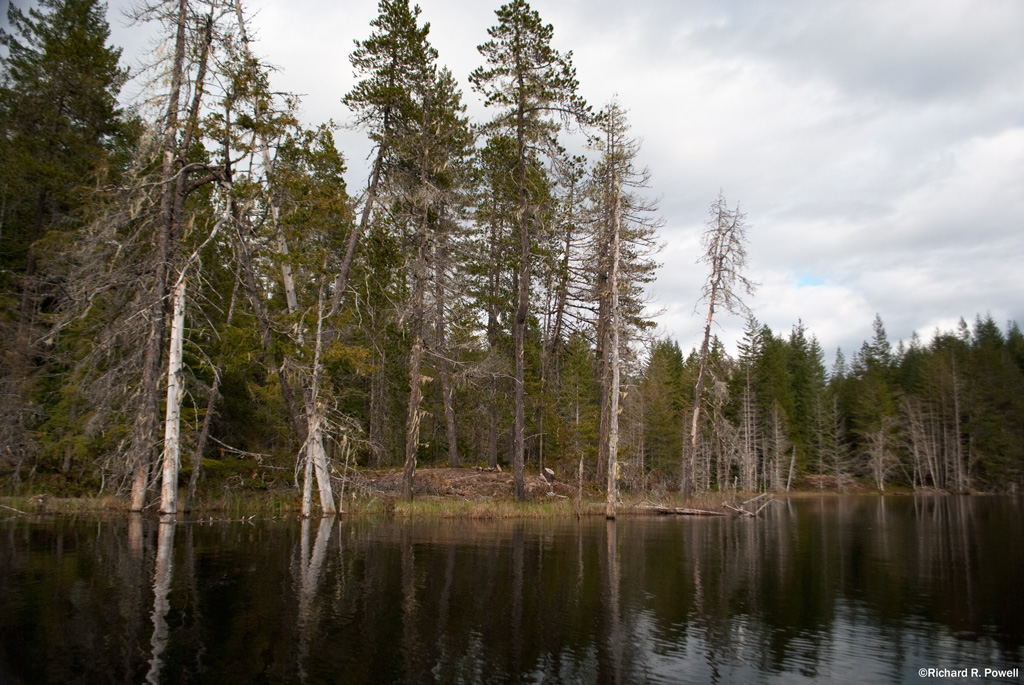
Larry Lake sits in a stoney depression on the top of "Hydro Hill" on the way from Port Alberni to Ucluelet and Tofino. After descending from Sutton Pass down the picturesque Kennedy River valley the road takes a winding jog up and over Hydro Hill before descending again to the shores of Kennedy Lake. It's one of those "blink or you'll miss it" spots, a mere gap in the rocks where motorhomes and 5th wheels pull out for a break. There are often anglers at the water's edge and the day I was there the couple who were fishing caught two nice trout on a simple worm in the time that I was out on the water.

The put in is a tad rocky and not ideal, but a light solo goes in no problem. I paddled the lake clockwise and within a minute I was behind the first point and in a different world. The traffic noise fades and there is the sound of water trickling down stone and wind through pine needles.

The First Point if Paddling Clockwise
The rocks drop steeply into the water and continue into the depth. Shore pine are everywhere, in appealing bonsai like shapes, and even the hemlocks are graceful in their form.

Hemlock
After making my way slowly through the first bay, I got out on the first little island which is really charming. Like spending some time on the back of a turtle.

Small Island

Small Island
As I paddled away from the first small Island I made a deliberate attempt to slow down and look at each tree and rock formation. There were some larger trees overhanging the water and a pleasing vista when I looked in almost any direction.

North Western Shore
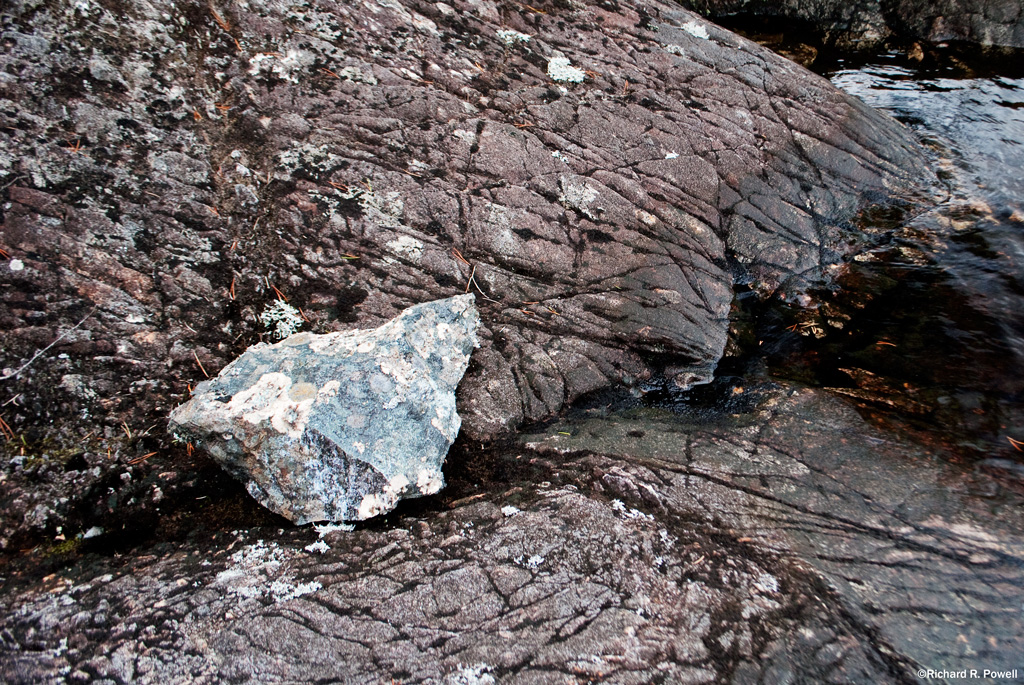
 Rounding the bend into the northern bay I had the great pleasure to examine up close a recently cleaved cliff revealing the complicated combination of limestone and basalt. The face was already stained with a variety of lichen and algae.


I paddled through the little bay on the northern tip of the lake where the only outflow from the lake drops sharply towards Kennedy Lake.

Lots to Look At
Then, feeling ready for some lunch, I made my way over to the "large" Northern Island.


A 60 second paddle.

Lunch in Sweet Solitude


A Short Climb to Look Down on the Lunch Spot

Looking North West

Everywhere a Bonsai

Evergreen Huckleberry -- not so green but lovely anyway!

Two Kinds of Stone
With lots to see in a very small area, Larry Lake has got to be one of the most compressed areas of beauty on Vancouver Island. Anglers know about it already, but I think the meditative paddler will find much here to contemplate as well.

Thanks Larry, your lake is awfully nice.

Saturday, 14 May 2011

Patterson Lake

Vancouver Island Backroad Mapbook 4th Edition - Map 24 E7
Atlas of Canada Link: Patterson Lake
Latitude and Longitude: 49o 20' 59" North 124o 58' 59" West

Trip Date:May 11, 2011

Me taking in the last warm glow of the setting sun on Patterson Lake
The sign at the head of Turtle Main is worrying. Then just past the power lines, a shinny new yellow gate, open but with the pin just sitting on top, like someone is planning to lock up later. I drive through reluctantly. Last night I had hoped to paddle on Trail Pond today. Something happened on that little gem of a lake that is forming an important thread in my new book. It had to do with a duck, and I wanted to paddle it again to be there and to remember in the spot it happened. But as I stand looking out on Trail Pond on the new road bed, covering over the old with a layer of rock and course gravel, I know I can't stay here. 

The hillside that slopes down to the road is newly logged. I let my eyes wander up the mess from stump to stump, to mud, to slash. The raw breaks on all the rocks give the sense that a lot of crushing has gone on. I think about the power of hydraulics, diesel, and the internal combustion engine. I try to imagine the cut in 5 year, in 10 years, in 20 years. This favourite place will not really be bearable for at least that long. Until then I will have to divert my gaze, or go somewhere else. 

Turtle Lake Main -- Information Sign
Today, rather than take a chance getting stuck behind a gate, I go somewhere else, up the valley further, to Patterson Lake. The land around Patterson Lake has not been logged for a long time, there are some nice patches of forest there. But I frown when I see the new road pushed in beside and on top of the old one. The old one had been beautifully gentrified by age, a shady trail on the verge of disappearing. I park in the old spot, bits of crushed rock scattered through the bushes and over the old road from the new road higher up the bank. The moss covered rock the children climbed on during the last visit has been decapitated. 

Despite my sadness, I decide to paddle here before it is logged, perhaps the last time I will paddle it for a while. I sigh, take down the canoe, put it in the water, and head onto the lake. 

The first time I paddled on Patterson Lake I had my two young sons with me in our old yellow fiberglass canoe. We were looking for fish, and the "lake" was a disappointment. Too shallow and marshy for fish of any size or abundance. We packed up and went to Dickson Lake that day. 

The peat Islands near the first Put in on Patterson Lake
Then, about 10 years later I returned on my own. I saw the place differently. I had different eyes, a different need. 

Kalmia microphylla -- Western Bog-Laurel near the first put in on Patterson Lake
Today I paddle out through the weedy channels and notice Western Bog-Laurel is in boom on the peaty islands. I examine the bog laurel to see if it's stamens are triggered or not. As the flower unfolds it's 10 stamens each have their tips tucked into a small pouch at the tip of the petals and there they remain, held with tension, until an insect comes along. As the insect seeks the nectar it brushes the stamen which springs loose and dusts it with pollen.

Kalmia microphylla - Western Bog-Laurel
The majority of the stamens on the plants I examine are not yet triggered. 

I move out beyond the peat islands and disturb some Canada Geese who honk at me and fly a short distance away. I turn away from them and go around an rocky island. Further down the lake a Kingfisher splashes into the water like a thrown stone, a flock of birds peep in the forest, creepers maybe, and the burbling call of a Winter Wren rises from a thicket of salal. 

Here is a video of my paddle through the first part of the lake. It is about 3 minutes long and due to the quality of the upload, the end is actually the clearest:

When I get to the main beaver dam, the new bull rushes are a foot above the water along the shallows and the old cat tails are inflated into fluffy plumes. I get out and carry the canoe over the dam and proceed down the lake. At the far end I can see the road again, and a new clearing on a stony shelf. 

The far end of Patterson Lake, where it drains towards Sumner Lake
Someone has arranged rocks for a fire pit. Last year when I paddled here, this end of the lake felt remote and safe. Now, it feels like all the other places in this valley, slightly trampled, threatened, vulnerable. 

The New Clearing
While I am pondering the change, a raven flaps down the length of the lake and perches near me, watching me. I wait for her call, for the warning to others. But all she does is turn around on the branch, tilt her head and stare at me for a long time. 

I go to the outflow and look over the lip of the dam down into the narrow little revine beyond. The beaver dam here is multigenerational, dirt and wood along the lip have filled in and formed a kind of solid mass. I turn around and head back up the lake, this time hugging the southern shore, looking at all the trees, remembering them. An eagle rounds the bend in the lake, flying between the trees and swoops down towards me. I look up as she flies over, the tips of her wing feathers dark against the bright sky.

As I approach the middle beaver dam again I here the high peeping of a duckling and look amist the burgundy stalks of a water shrub and see a grey and white speckled ball of fluff, it's big eyes in it's small head. I hear another peeping start up deeper in the sticks, and then another. I look around for mom or dad, but they don't seem to be anywhere around. 


I paddle on and when I step out of the canoe at the beaver dam the late afternoon sun comes out and I set up my tripod to take a photo. Then I take a couple of shots of myself as if to say, I was here when...


Patterson Lake is on Timberland land, privately owned, gone forever from the commonwealth. Part of land that was traded to a coal barren for a railway. I paddle here because of the benevolence of Timberland, because of Timberland roads, and because the province of BC enforces certain rules on logging practices. 


The trees within a short distance of this wetland's shore will not be cut. Patterson Lake will be preserved, even if the forest around it is taken. 

I feel weary as I load up my vehicle and wash the pond algae from my canoe. I turn off the radio as I drive through Port Alberni. Cameron Lake is as flat as I have ever seen it when I drive by. I had gone to the woods for restoration, for rejuvenation. I'm filled with a mixture of gratitude and sadness. Sabi is elusive today.

Sunday, 10 April 2011

Betty's Petite Yonah

Trip Date: April 9, 2011

I pick up Jeff at 8:50 and we head to the Whitespot to break our fast with the rest of the Sedgebenders. Discussion ranges from how the Sedgebenders got started to the strike at the local University. Several of us, including me, have the Giardino omelet. The Arrabbiata sauce is fresh and "yum!"

When we are finished eating we head to Westwood lake for the main event of the day, the christening of Betty's new Clipper Packer canoe.

Clipper Packer

Clipper built this boat to exacting specifications: "Dr. says no heavier than 22 pounds." Gotta hand it to the Clipper folk, they pulled it off. Think they were pretty proud of her themselves -- as suggested by their blog post about it.

Clipper Packer and Three Other Canoes
 The canoe has that fresh kevlar gleam and we admire the cleaver design -- graphite reinforced foam ribs and elegant wood gunwales.

James and Charles examine the gunwales
Notice the graphite seat which sits atop a foam core graphite substructure. Both the seat and the foot rest are nicely adjustable.

An Awfully Pretty Design
I have not seen a Packer before so appreciate having a good long look at ever inch of her. Many elements of the design are subtle. There is a slight tumblehome and the paddling station is roomy, easy to get in and out of, but also snug with comfortable access to the water.

A Simple Curve to the Gunwales
When we are all together James reads two Wendell Berry poems and I an excerpt from Paddle Whispers by Douglas Wood. Then we open some Campaign and toast the day and the occasion.

Water and Wine

I Christen thee Petite Yonah
It's Official
 Then we prepare for departure. Betty is the first off.

Light as a Leaf
Paul is next, followed by the rest of us.

They're Off
The day so far has been better than expected, some clear breaks in the sky and fairly calm, but of course as soon as we are on the water....

Jeff and I are in his Cedar strip Tandem built by his Brother in Law

Paul in his Solitude and Betty in Petite Yonah

Wind Gets Up
Oh the Joy of Paddling Your Own Canoe

Betty Seems to Think it Was a Good Choice

Lynne and Charles, Long Time Paddlers, Put Paul's Clipper S Through It's Paces

Back from the Paddle
 The Clipper S is outfitted with knee braces, a foot rest, and a kneeling thwart. Very nice.

The Packer Does Have a Nice Little Bit of Rocker
After we get back to the put in, Betty allows Paul and I to take Petite Yonah for a spin. Paul has loaded 2 water bags for ballast and shifting the bags around produces changes in the trim. Paul comments on the noticeable difference this makes in tracking. The little craft has lots of buoyancy and we agree that it could be loaded with a fair bit of gear for a trip.

Paul has two paddles to try, his ZRE classic carbon and a maple otter tail. The little Packer leaps up to speed with the ZRE and when I take up the otter tail I find the boat handles extremely well. It also is remarkable for it's good initial AND secondary stability.

I try a variety of strokes and find that the boat responds well to my favorite, the Indian stroke. Sculling is easy and an abrupt switch to a reverse scull doesn't freak me out -- that ample stability is really nice. Turning is easy, perhaps because of the Packer's modest rocker, and yet the boat seems to track well. In general the hull slides along very nicely without too much effort. No wonder this boat has stayed in production. It is a winner.

The Sedgebenders

Sunday, 30 January 2011

Losing the Light

I stand alone on a weathered outcrop of Quatsino Formation Limestone, hands in my pockets. The lake stretches before me.  The heat spike of midday generated wind, stirred up waves, filled ears with the buffeted rasp of rushing air - the smaller sounds were lost in the white noise. But now it is letting up. Silence is piling up between the grass blades. Waves slap out a quiet metronome against a limestone pillar off to my left and gurgle amid the eroded shapes at the base of the outcrop. The long shadows of the trees no longer move over the ferns and moss where I was sitting a few minutes ago and dusk is gathering inside the forest. There is a Gaussian blur at the edges of everything.


I hear my father's voice in the back of my head, "we are losing the light; we better get back to camp."  He retreated to camp towards the end.  Not a surrendering, just a practiced prudence. My mother too, gave up her hope in fairies for the surer offer of a guardian angel and Jesus.


As a boy I noticed the books dad read. His Saturday mornings at the kitchen table; coffee and a paperback. James Michener, Tom Harper, Farley Mowat, C.S. Lewis. His choices sometimes courageous. He faced ideas, arguments, squarely. He deliberated in the prickly discomfort of uncertainty. I remember him reading Kierkegaard, his eyes moving back and forth while I poached an egg.  A slim book, but hard. "You can read it," he said, "anyone can read it. Understanding it though…." And then years later he quoted from it. One line drawn out, memorized because it was worthy, a perfect expression of something my father understood. A small perfect reminder carefully sequestered in his mind:

"Only one deception is possible in the infinite sense, self-deception."

Richard Emerson Powell (Dad) Reading in his Retirement Years

He quoted Robert Burns, often. Liked, To A Mouse. Not the popular verse 7 with its "The best laid schemes of mice and men go often askew, and leaves us nothing but grief and pain," but instead the first verse, in the original,

"Wee, sleekit, cowrin, tim'rous beastie,
O, what a panic's in thy breastie!
Thou need na start awa sae hasty
Wi bickering brattle!

I wad be laith to rin an' chase thee,
Wi' murdering pattle."

In his younger days my father was a hunter. He taught me to shoot and cast a fly. But by the time I was middle aged he had given it up; first the deer, then the grouse, lastly the trout. In the end the burs of wilderness stuck only to his jacket. Inside was receding dust and ash from two orbiting planetoids:  refined tender awareness; and a stubborn satellite of fear.

Richard Emerson Powell (younger than I am now) shows a grouse to the Little Black Bandit From Ghost River Ranch on a hunting outing when I was a 15.

The Burns poem was cherished because the ploughman in the poem, Burns himself, felt great kinship with the mouse who had worked so hard to prepare for the winter only to have his house devastated by the passing plough. The ploughman realized that his life required him to plough, yet to see the small creature put out of his home was pity.

"I love that," my father would say, "the sound of it and the just of it." 

He loved it because it was almost a different language, yet even if brattle and pattle were unfamiliar words, there was enough comprehensible that the incomprehensible could be guessed. That, it seems, is how we get along, my father and I, comprehending what we can, and guessing at the rest.


I get up and make my way back towards camp, walk through a forest, deep moss spongy underfoot. I pause to listen to the ringing stillness under the cedars. I emerge onto the stretch of sand and walk close beside the water on the hard plank of smoothly washed sand. The gentle lapping of the waves as I idle along the beach, the low angle of the sun revealing deeper tones of amber and blue.


Night brings the cool awareness of how thin my clothing is, how long a bear's claws are, how squishy I am between my bones. The heat goes out of me, the darkness an insatiable absence, the inexorable force towards death. Only the sun is excessive enough to sustain us. When it is elsewhere, we all zip up, wait, shiver.

My father, his aging heart expanded, his fear of darkness crowding in, turned to religion. He had always turned to religion. He trusted it. And the religion he turned to was a vagabond companion.

My father's "tenderness" snuggled alongside of several other virtues he had selected and nourished over his lifetime. One of those was reverence, and his religion seemed confused on the subject. He still had the idea, despite his own rationalizing to the contrary, that a church was a unique place where you presented yourself before God, made your confession, and accepted absolution. Church as forest glade.

It bothered him that the new community, made mostly of a new generation, didn't wear formal clothing to church, a niggling problem with no solution.  How could they not see that it was disrespectful, that being off the hook didn't mean a licence to slovenliness? It also bothered him that those outside the church couldn't accept the gospel. Why, he puzzled, could people not just accept this gift, this forgiveness and life? He must not be communicating it correctly; the fault must lie with him. He would have to try harder. He talked and talked; his loved ones shying away from the intensity in his voice, horses unable to put hands over their big ears.  In the light of death, he wanted to shout, it was all so important; this one decision for Jesus.

Richard Emerson ties a fly to his fly-line as we walk between lakes in the Kootenay Mountains
The darkness sucks and sucks. And as I stand on the lake shore, feeling it suck the heat out of me, I think about my own decision for Jesus.  Year after year, inexorably, unrelentingly, the darkness had sucked my faith away.

Like my father I turned to the close warm comfort of that old story, I turned like my father, to that faithful friend religion. Looking for the place to nestle deeper, looking for the red checked wool coated chest of my Father Writ Large, fresh in from splitting wood, fresh in to hug me, reassure me it was all going to be ok.

I am the mouse turned out. The plough crashed through my house; I face the winter alone, without shelter from the icy facts of a dark cold universe. Others seem able to hold on, but I keep slipping off the over turned hull of Christianity. I am the weak one, the doubter. I will surly drown.

In Fear and Trembling Kierkegaard argues that you can hang in a belt from the ceiling and make the motions of a swimmer, but throw yourself in the river and you find that the motions you made while hanging in the belt, no matter how practiced, don't make you a swimmer. He says that the same is true of faith; that going through the motions, or "wearing the jewel of faith," as he puts it, is not the same as living it.  From the outside the two can look the same, real faith and faith as an overcoat.


He then goes on to give one of the most satisfying portraits of the engaged individual I have read, a person interested in everything, celebrating everything, entering in wholly to everything from his evening meal, to the frosty walk to church,  to the singing of psalms with his neighbours. Moving through each moment aware of it, absorbed in it, revelling in it. A mind alive.

This to Kierkegaard was the spine, the place to hang a body on, and paradoxically, the place to let go of the body.  He says, "Carefree as a devil-may-care good-for-nothing, he hasn't a worry in the world, and yet he purchases every moment that he lives, 'redeeming the seasonable time' at the dearest price; not the least thing does he do except on the strength of the absurd. And yet, and yet - yes it could drive me to fury, out of envy if for no other reason - and yet this man has made and is at every moment making the movement of infinity."

The movement of infinity.

Kierkegaard says this soul has discovered that by practicing resignation infinitely he can achieve a tranquility that "drains deep sorrow out of existence." The key, I think, is loss. Resignation in the positive sense that Kierkegaard means it, is acceptance of loss. Yet once accomplished, this movement from hope to acceptance allows the individual to take each pleasure as a gift. When you face loss squarely and really look at it. Look and look and look and do not turn away. "Ok, I've seen it, I am less secure, robed, diminished." Then each kindness is a marvel, each green bud a miracle, each grain of salt a wonder.


Loss is a hinge for the door of gratitude to open on.

But Kierkegaard says this "knight of infinite resignation" doesn't have the highest bliss, though he does have "the bliss of infinity," and that highest bliss is reserved for the one who can leap into the absurd position of believing he will get it anyway.  He uses the example of a dancer who leaps and lands exactly on mark, and is able through practice to turn walking into a perpetual act of leaping. The absurd is any situation that defies rational explanation but never the less is. It is the religious experience of trusting that all will be well, even when there is no reason to believe this. Absurd is irrational, illogical, emotional, intuitional. And by launching oneself wilfully into this state, one achieves the highest bliss. According to Kierkegaard.


On Monday nights I travel with my friend Ian to a group that meets in a church. Recently we watched a DVD series called "Saving Jesus." One night, we faced the change that comes when we let Jesus be human. Fully human. Let fear stand up on it's hind legs and growl. Look and look and look at it. There is an antidote to fear, one of the speakers on the DVD hinted. It is trust. "Trust? Is that true?" I asked. Everyone thought about it. No one was in a hurry to agree or disagree. Someone suggested that it is love, not trust, which casts out fear. "I think that is a scripture verse," someone said.

Later I look up the verse. John 4:18. The context is judgement - fear of judgement. And love casts that fear out. I realize that judgement is not what I am the most afraid of; even though Rabi Kushner says that the fear of rejection is the most frightening thing of all.  No one wants to be cast into the outer darkness. Unliked. Unwanted.  Alone.


In theory the idea that we are loved by God, that our religion insures it, casts out the biggest fear there is. But all fear? If God loves you, can anything else matter? But bad things happen. We can not trust God to keep us safe, because we are beaten by the neighbourhood bully. We can not trust God to provide for us, we lose our job. We can not trust God to keep us safe from cancer, we get it anyway. We can not trust God to keep us from dying. Every single one of us does. There are bears in the forest.

So if trust is the antidote, and we can't trust God, what do we do? Religion isn't about belief, it is about who you belong to, says Rabi Kushner. It is not really about answers, certainty, or comfort. Real religion is just the reassurance that others know our name, that others will listen to our story, remember us when we are gone. Stand around our grave. Religion is human companionship. The opposite of being alone.

As the Quakers might say, "we trust that of Christ in everyone, in everything."

The river into Wolfe Lake where I found some wonderful volcanic rocks in red and green from, no doubt, nearby Mount Pinder
Perhaps that is why on this Sunday I spent the day studying the mountains and trees, opening my soul to deep green star embers and the difficult choice between wading in the creek looking for pretty stones, or doing the same at the lake edge. This is where I belong, this is my sanctuary. I meet God here.


I crawl into my tent, zip up the flap, pull the sleeping bag up around my ears. If a bear comes, I think to myself, I will not have anyone else to help me, I am in the outer darkness. I have arrived at an absurd moment. Yet really, I am not alone. The humans that lived before I was born impressed upon all the other species that we humans are dangerous, not food. If I can relax a bit it is because my aunts and uncles before me, for millions of years, have banded together against the darkness. I have their memory in the genes of bears, and I have bear spray and a tent. The community of humans is all around me, even when I am alone.

This thing I do, here in the dark, is a kind of swimming. I am not hanging in a belt, I am not thinking about sleeping in the wilderness, I am about to actually do it. I lay my head down and entrust my life to the long evolution of my species, and the parallel evolution of the bear. It is risky, but a calculated risk. I'm back at camp, the light is gone, and I leap into the absurdity of sleep.